THINK BEYOND THE FACTS, THINK CONCEPTUALLY
  • Home
  • Services
  • Free Resources
  • Blog
  • About
  • Contact

Concepts in Action

An inquiry into... Ashti/Bakea/Paz [Peace]

1/21/2026

0 Comments

 
Picture
While I have played witness to conflicts throughout my lifetime both at home and around the globe, the last 10 years working and living in Iraq, Turkey and Spain have challenged my worldviews significantly. As an international educator, I feel compelled to dig into concepts related to interculturalism, global citizenship and sustainability. We all experience the world differently given our own schema - funds of knowledge and identities. It is an ongoing endeavor to train my brain to listen for understanding as an open-minded observer: to understand other ways of seeing, hearing and doing as well as to accept these differences while looking for the commonalities. Then, it is our common humanity - human dignity that surfaces to the forefront for me. I can build cultural bridges for constructive relationship that work from a place of care and wisdom.  

My time in Iraq was impactful as I arrived during the war with DAESH. My students were daughters and sons of parents who had experienced the Baathist party's war on diversity, free speech and thought. This experience drove me to focus two of my research papers for the University of Bath doctoral program on Iraq so I could better understand the region, the constant turmoil that leads to waves of conflict and the history of my husband's Kurdish family. What I uncovered through touring the Kurdish north, teaching Kurdish children for 3 years during the ISIS war and then through my research is reflected in the image below.
What happens when we begin to see people as others, less pure, worthy, intelligent, or human? I leave you to draw your own conclusions...
Picture
I came to discover the richness of the Kurdish culture - they are so much more than the stories of pain and loss. These pictures I took while touring the countryside are to remember and learn from the past. Over time, I have witnessed the Kurds as a progressive people who care about equal rights, who empower women, have strong family values and welcome visitors with tremendous hospitality.
To read more explore...
  • https://halabjamemorial.org/ 
  • https://www.newtactics.org/perspectives/amna-suraka-unexpected-place-healing/ 

Picture
In 2023, we immigrated to Spain for two years. My first trip to the Reina Sofia Art Museum, I got to spend time observing Picasso's work, Guernica (which I have now seen on 3 different occasions). I have to admit, at that time, I was ignorant about the Spanish history behind the painting entirely. The painting itself is massive with so much symbolism and I found it difficult to understand as I lacked the background knowledge. I knew quite a lot about World War II and had visited many memorials across Europe back in the 80's and later the Holocaust Museum in Washington, DC. I had read books and taken World History and Geography at the university. However, I had yet to understand the role of Spain, Franco and Spanish fascism during that time period as well as the history behind the Spanish Civil War. I had seen movies (in Spanish) that impacted me like Pan's Labyrinth (El Laberinto del Fauno) and Butterfly's Tongue (La Lengua de las Mariposas). So like I have done in other countries I have immigrated to, I began to educate myself more about Spanish history by traveling and visiting museums to learn my host country's stories, perspectives and challenges.

Picture
One of our first trips was to the Basque region in northern Spain as I wanted to learn more about the region. Picasso's painting provoked significant curiosity to learn more. We booked a place just outside of Bilbao, in a hotel that was a converted mansion (see image to the left). This trip took place over a long weekend because of The National Day of Spain (October 12) that celebrates the voyage of Christopher Columbus and the spread of Spanish culture and language across the Americas. When we arrived at the hotel, I quickly realized that the Basque region does not celebrate no do they appreciate this holiday. Over the weekend, I learned about the uniqueness of their language, culture and historical experiences. Basque is a language that is uniquely its own with no connections to Castellano or any neighboring countries' languages for that matter. The people have safeguarded and protected their language by using it; it is taught in schools, used in public signage and menus and in daily interactions.

Picture
 The Guernica Peace Museum [Museo de la Paz de Gernika], Spain
The trip to Gernika (Guernica) did not start as an inquiry into peace for me. It unfolded throughout the visit to the museum itself. It is a powerful museum that confronts the visitor with the concept of peace through an epistemological lens. Additionally, I made connections to my prior research that I did for my coursework at University of Bath as well as life experiences while living abroad.

​I spent a lot of time that morning slowly reading the various case studies highlight in the museum. These activists over the years who have fought for peace by advocating for freedom of speech (economic status, race, gender), equal representation (economic status, race, gender), an invitation to participate equitably in the legislative process and the access to equal rights for all. Provocative questions ran throughout the exhibition...
  • What is peace? 
  • At what cost do we (society) achieve peace? 
  • Who pays the price for another groups’ peace?
  • When peace is obtained at any cost, is it peace?
  • What is the relationship between peace, participation,  representation and marginalization?
Then to experience the museum itself learning about the bombing experience, reading the stories of survival and loss. It provoked me in a good way. Since visiting this museum, I see the headlines and daily streams of news differently. I connect back to peace and then the macro-concepts of my research studies.

While there, I purchased this book by William Smallwood (pictured above) who was the first reporter to arrive and document the events from primary source survivors.

The Museum of Peace courtyard with images of the bombings to learn about.
Bakea - peace in basque language
'Rememorar su vivencia es intentar entender el pasado y sus errores; sólo así podemos mejorar el presente y trabajar para el futuro'
Following this short visit to the Basque Country, I began to get to know my neighbors in my urbanización [apartment complex] while lounging at our common pool area together. I learned that several of my neighbors grew up abroad and only returned to Spain in the late 70's following the death of Francisco Paulino Hermenegildo Teódulo 'Franco' Bahamonde (November 20, 1975), the former General and dictator of Spain since 1939.

At work, I began to listen deeply to my Spanish colleagues and the families. I began to see that there are histories, wounds and conflicting beliefs that continue to create tension points for the Spanish around me. The Spanish film industry continues to tell stories about the past and I highly recommend these:
  • The Time in Between (El Tiempo entre Costuras)
  • The Professor who Promised the Sea (El Profesor que Prometió el Mar)
  • The Endless Trench (La Trinchera Infinita)
  • The Patients of Dr. Garcia (Los Pacientes del Doctor García)

Hopes for a Sustainable World
As an international educator now for over 22 years, I have internalized a more global perspective that seeks to understand other cultures, countries and peoples rather than to categorize, label and de-value them through "othering" or by using a deficits-based lens. Over time, I have felt increasingly connected to the cultures and countries who have welcomed me to contribute to their society through residency. Now, I see the world increasingly intertwined, as interdependent sectors who can support and benefit from one another for a sustainable global future. I find myself fully aligned with the ideals of the United Nations as stated in these documents below:

​Universal Declaration of Human Rights
UN Convention on the Rights of the Child (UNCRC)

Secondly, I recognize that I stand on the shoulders of so many women who came before me to fight for equal rights - the right to citizenship independent of a man, the right to vote, to own property, to have a bank account, to drive a vehicle, to travel independently, to determine a career path... it is a long list for certain.

Current global events challenge the very fabric of what I have taken for granted - the norms of honor, integrity, respect and global collaboration ever since the formation of NATO and the end of World War II. If we all have human rights, why do governments exclude demographics and excuse themselves from obligations to honor those rights with distinct people groups? Look at the following timeline:
  • February 2022, Russia invaded Ukraine. I was in Turkey at the time and we received many displaced families. to our school. This war continues... and who knows what the outcome will be or when it will end. This war has put to test relationships within and between the EU, the USA and the NATO alliance in general at times. 
  • October 2023, Israel went to war with Hamas, decimating the Palestinians of Gaza. This also continues with ongoing calls for humanitarian aid. It is heartbreaking to watch the suffering that is happening there.
  • The USA by a sweeping majority, re-elected President Trump who took office once more in January 2025. Since taking office, there has been increasing polarization, threats, revenge tactics and a break-down in the democratic processes. I find the videos of ICE at work disturbing and upsetting.
  • A glimpse of hope for the future of the USA in the election of a new mayor, Zohran Mamdani. He is an immigrant, a muslim, so intelligent, kind and a visionary reformer! He is showing the USA what democratic socialism looks like - when the government serves the people for the common good to make life easier. 
  • There are widespread protests in Iran taking place that are resulting in many deaths.
  • Now, January 2026, the rights of minorities in Syria including the Kurds (near and dear to my heart because of my husband), the Druze, Alawites and Christians. 
This fiction was useful, and American hegemony, in particular, helped provide public goods, open sea lanes, a stable financial system, collective security and support for frameworks for resolving disputes.
So, we placed the sign in the window. We participated in the rituals, and we largely avoided calling out the gaps between rhetoric and reality.
This bargain no longer works. Let me be direct. We are in the midst of a rupture, not a transition."
Canadian Prime Minister, Mark Carney, at the World Economic Forum in Davos 
Watch the full speech at the World Economic Forum in Davos, Swizterland 2026.

Picture
Global norms are shifting, cracking and begin to break down. The world as we know it may be changing beyond what Artificial Intelligence is changing. As an expat, it is hard to believe and accept. I am unable to accept the increasing rhetoric of hate as well as the ostracizing tactics that I hear coming from politicians in the country of my birth, the USA.

​What does one do in the face of polarizing political rhetoric?  Or the dehumanizing actions by government officials who we expect to protect us? Or the outright aggression that results in wars?​
Picture
Don't forget the Russian invasion of Ukraine and the Ukrainians fighting for their freedom. ukraine.ua
Picture
ICE agents in Minnesota create high levels of fear...
Picture
The brutality of Al Qaeda / ISIS returns to the Kurdish regions of Syria. Kurdistan24 English
Picture
Days of protests for Iranians upset about the economy and a renewed desire for freedom. H. Nedwill Ramsey Professor at the University of Pennsylvania
Picture
January 25, 2026: Protests continue, Oppression and violence against protesters scaling up; Death tolls rising
The nagging in the back of my brain returns to the concept of peace. And the ways we can guide our students to be inquirers into the concept of peace. We cannot hide our students from what is happening in the world. One action international educators can take is to use the current events as points for an inquiry into peace. ​
Picture
Position Statement – Strand D: Leadership, Management, and Teacher Development

“Alliance for International Education World Conference 2025” hashtag#AIE2025

Our schools must be places where young people and our wider communities experience and demonstrate peace, social justice, and equity not as abstract ideals, but as lived realities shaping their daily learning and growth.

As leaders, researchers, and educators within international education, we affirm our collective responsibility to embody peace, social justice, and equity in both vision and practice. Leaders play a pivotal role in ensuring that these values are not only articulated in mission statements but lived daily within our institutions.

Together, we commit to leading with courage, compassion, and integrity, ensuring that international education remains a force for peace, justice, and shared humanity

0 Comments

How we launched a new Lower School

6/21/2024

0 Comments

 
Picture

We do not always get the opportunity to launch a brand new school aligned wholly to our beliefs, values, experience, knowledge and understanding. In 2023, I was trusted with this responsibility; I was given the chance to sell and enact a vision for a program founded on the principles of Concept-Based Curriculum & Instruction with the pedagogies of Play-based and Playful Learning. Additionally, I was able to organize an approach to Language & Literacy based on context, that balanced Structured Literacy (elements of the Science of Reading) with the Teaching and Learning Cycle of Systemic Functional Linguistics. This functional approach allows learners to inquire into how language works. Not to mention, the full participation of our team in the the CBI Mathematics Project pilot while integrating the works of Pam Harris, Cathy Fosnot, and Jo Boaler. 

AND then to build such a collaborative, constructive curious team who willingly took the risks while supporting one another for full implementation from day one! Through transparent data sharing, we leveraged our team's expertise to challenge every learner appropriately.

After 2 years of implementation, our team saw significant measurable growth for ALL learners in language development, literacy skill development for decoding, fluency and comprehension, mathematical reasoning & understanding.

We reflected together on all the observable skills for lifelong learning that we saw begin to blossom: self-management (resilience, executive function), collaboration and community building skills for building norms and respecting agreements, the ability to generalize understandings, and to pose thoughtful questions.

Our 2025 spring performance, was the icing on the cake. Our learners demonstrated tremendous growth in performance skills: stage presence & protocols, choral performance, harmony, drama and dance with props, and oratory skills.

Enrollment grew by 225%!
​Happy families spread the word...

Picture
Our caring, curious, persistent and creative founding Lower School team embracing the challenge head on!
We designed and launched a brand new program for Brewster Madrid. Our original campus in New Hampshire, Brewster Academy, has existed for over 100 years as a high school (day and boarding). We looked at the Portrait of a Graduate and scaffold back.

Read further to learn some of the steps we took.
In July 2023, our founding team members came together committing to a shared vision. This vision focussed on building a caring community using an exceptional approach to learning and teaching. We truly believed in our school mission, that we prepare diverse thinkers for lives of purpose. We united around our guiding statements enthusiastically to build a Lower School program for Brewster Madrid that would realize our school's vision statement: an approach to learning that has the exponential power to transform education, communities and the lives of our students.

​What follows are pieces of the story behind our thoughtful intention, the aspirations to build a gold-standard, exceptional Lower School program using processes, structures, and systems to personalize learning. We are proud to say that Caring, Curious, Persistence and Creative manifest across our program.
Community Building - Relationship, Partnership, Caring
The first step with any new role or initiative begins with community, belonging and relationships for learning. During our Brewster Summer Institute, we had 30 hours designated to our Lower School division time. A large proportion of this time was dedicated to coming to common understandings. As the founding team, we made decisions together that would drive the direction of lower school pedagogy and program for Brewster Lower Schools henceforth. 
Picture
Picture
Picture
It was important to me to make space for full participation in decision-making and programming. I took intentional steps to invite participation for shared ownership,  responsibility and as a motivator for professional learning. I invited questions, proposals and identified together pending projects. We began this process by using an inclusion activity that opened the door to sharing who we are (schema, funds of knowledge) with one another.

We considered rituals and routines that would be evident across the Lower School. Ideas elaborated in the images below guided our school launch and evolved from here. Over time, morning meeting evolved to include SEL focused time as well as safeguarding and child protection lessons.
Picture

Rituals and Routines: Unity, Community
Picture
Picture
Picture
Picture
In order to build our essential agreements for collaborative, psychologically safe interactions, we began with a JIGSAW activity to dive into some research (audio and journal articles) about constructive relationships. Building a common understanding for learning would help us interact in caring, professional ways. Themes examined included:
  • Collective Responsibility - Jennifer Abrams
  • Psychological Safety -  Dr. Amy Edmondson & Dr. Fran Prolman
  • Nurturing Wellbeing - Dr. Helen Kelly
  • Emotional Regulation - Adam Grant
  • Teaming - Dr. Amy Edmondson
  • Trauma-Informed Practices - Vicky Kelly, Mays Imad

The Formation of Strategy Teams: Curious, Persistent, Creative
We divided up into small working groups to take ownership for driving the documentation of our philosophical and pedagogical approach: best practice research, content, strategies, skills for clear scope and sequence documents. As a completely new program, we had to ensure alignment across the grades. This would also ensure that our practices reflected the sales pitch our parents heard. 

What documents needed articulation?
  • Collaboration in the Lower School: This document encompassed all of our Essential Agreements for interactions, ongoing meetings (a wide variety of types of meetings), homeroom/specialist responsibilities for tier 1 instruction, steps to collaborate with learning support for tier 2 or 3 support, approaches to behavior issues, playground agreements, etc. Over two years, this document expanded to articulate all expectations clearly.
  • Assessment Handbook: This document encompassed our approach to assessment elaborating our cycles of reporting through conferences or formal student reports. It also elaborated ways to conduct assessment, to triangulate data and how to use assessment to make decisions about teaching and learning.
  • Language & Literacy Scope and Sequence: This document encompassed our beliefs about language development and literacy instruction. We strove to align to the Science of Reading through Structured Literacy and the application of a functional approach using Systemic Functional Linguistics. It explained the strands that must be included in the homeroom practices each week for holistic literacy instruction. It also elaborated the AERO standards and UK Birth to 5 Matters for the Early Years. This document also included our host country, the Spanish Language for homeroom teachers to be informed.
  • Philosophy of Play: This document opened the discussion to our Early Years team and how we would approach learning and teaching in Kinder 1, 2, 3 and into grade 1. We had to learn a holistic, developmental program that made space for play with a team who had not been exposed to play-based learning yet. In the document, we defined play and playful guided by Harvard Project Zero's newest publication. Then we began to unpack over the next two year, through ongoing training, what continuous provisions implies; how we can invite, nudge and provoke interest; the role of the teacher and the role of the student. Over time, we wanted to have the resources and spaces for play-based learning to always be available to all ages on campus. 
  • Mathematics Essential Strategies: This supporting document encompassed our approach to reasoning by developing skills for problem-solving through strategies that build and extend upon one another. This aligned to NZ Mathematics and Pam Harris' resources for problem strings as well as her top models and strategies document. Our school chose to participate in the CBI Mathematics Project Pilot which would take time for us to fully understand and internalize the phases and understandings. So, it remained important to us to map out our strategies and models sequentially.
  • Documents launched after school start:
    • Technology Usage / Digital Citizenship / Scope and Sequence
    • Social and Emotional Learning / Safeguarding and Child Protection

Picture

The Design of our Initial Program of Concept-Based Inquiry

As a CBCI consultant, I took the team through the introduction to teaching for conceptual understanding. We reviewed the Structure of Knowledge, the role of facts and concepts, the ways to identify a concept. Then we reviewed the purpose of learning to scaffolding the thinking by assessing generalizations. It is important to understand why we generalize and how we assess those generalizations - statements of understanding. Then we reviewed the the types of questions we can pose.

Additionally, every teacher was provided a copy of Concept-Based Inquiry in Action which became our guide for a book study throughout the school year. Also, we frequently referred to it during collaborative planning meetings when thinking about strategies to use at each stage of the cycle. To further support this process, our team also joined the CBI Mathematics Project which organizes units aligned to the same cycle for inquiry leading to generalizations as a form of assessment.
​
Using the Standards that we had agreed upon, we began to identify the concepts that we could use to build a program of inquiry. It was a messy process with lots of sticky notes and moving concepts around. We began with science and then added social studies until we could identify the conceptual lens that would be the driver of the unit. This would allow for authentic connections by specialist teachers. This was an initial attempt with almost all teachers new to inquiry-based learning except two. There was great enthusiasm as we brainstormed in small teams the units of inquiry for the upcoming launch. As small groups began to present their units of inquiry, they share their reasoning for the units and how they drew upon the standards. Others across the team provided feedback for further revision or adaptations. I chose to take a supportive stance even when I saw some units as potentially challenging for one reason or the other so that teachers could thoroughly experience the process of creating a unit, rolling it out and then later reflecting and revising based on their own experiences with the units of inquiry. 

Time and ongoing support would be the strategies that we would rely upon to build strategies and tools for full implementation. Our team as well as our brand new incoming cohorts of students faced a sharp learning curve. The majority of our students transferred because of a learning challenge and they had never been exposed to inquiry-based learning. It would take time!

Picture
In June 2024, we conducted a vertical and horizontal review of our Program of Concept-Based Inquiry to improve our units of inquiry as transdisciplinary learning opportunities. Our review process intentionally uses processes to provide participation that is authentic and agentic. I want to see teachers in reflective conversation about practice and content. This yields meaningful changes for improvements. Taking the time to make it interactive always pays off. Teachers are active, on their feet, observing, discussing and making notes. This brings the level of energy up, engagement increases and participation is more meaningful.
Our Spanish Department used this process to see how to integrate Social Studies and Civics into the POI in relevant ways.
After organizing the curriculum, they taped the curriculum where it was relevant on the various POI transdisciplinary themes and grade levels.
We also conducted a thorough review of our entire program in general by identifying strengths and areas for growth.
This process led to the identification of goals for the upcoming school year.
Initially, we worked with teachers individually and virtually (Murcia campus) to strengthen our units of inquiry by considering adaptations that would allow increased connection to local context. This would support authentic opportunities for research. Some of our units of inquiry lacked enough breadth for transdisciplinary learning so they felt locked into one discipline. So we wanted to improve that by expanding opportunities for integration within the homeroom disciplines as well as the specialist content integration. We wanted to make our POI provide meaningful ways to engage with the local community of Madrid and then make connections to global issues (17 UN Sustainable Development Goals).

Secondly, we wanted to review all our decisions about programming (curriculum content, handbooks and philosophies) to assess our progress towards program articulation and alignment. We reflected on every element of our program and it took a couple of meeting times to conclude that reflection for goal setting.

Ongoing professional development on restorative practices conducted by one of our team members. This was supported by further development of our handbook on learning support as well as identifying a curriculum framework to include in our program - Second Step with Safeguarding and SEL Curriculum Standards and Benchmarks by ICMEC and CASEL.
Picture
Picture
Picture
I facilitated ongoing professional development on Systemic Functional Linguistics after school to make SFL relevant and accessible. These lessons were organized for a grade 2 classroom level; however, the lesson lab experience opens doors to ideas for ways to make adjustments for different levels of challenge.
PicturePosted by Julie Stern on LinkedIn
End of Year Professional Growth Reflection
In June of 2025, our Lower School team dedicated time to reflect once more. This time, I organized a reflection that focussed on a continuum of personal growth and development through the lens of our pedagogy. If you click through the images below, you will see examples of the continuum (beginner to world class). Based on feedback from our NEASC visitor, we had focussed our program on 4 pedagogical anchors as follows: 
  • Concept-based Inquiry
  • Approaches to Learning
  • Inclusion and Differentiation
  • Progress Monitoring and Reflection

I asked our team members (including myself) to honestly consider personal strengths and potential areas for growth. Areas for growth can be seen as opportunities to explore and extend on what we know now. They do not have to be seen as a weakness. The objective was to end the school having given thought to goals for development and making those reflections visible to our community. This information would inform the faculty meetings calendar for PD as well as the identification of resources for supporting PD.

This image above highlighted by Julie Stern on LinkedIn was helpful for guiding our conversations with a trusted colleague. I encouraged everyone to partner up with a trusted colleague to discuss how they were growing and what personal goals he/she might be considering to move their learning journey forward. Everyone on our team participated, including myself. The energy in the room was engaging. Teachers were reflecting, writing reflections and sharing honestly with one another. Exit tickets were used by each individual to identify personal strengths and areas for growth.

UPDATE:
Unfortunately, I was unable to see this endeavor through due to sudden layoffs over the summer of July 2025. It is terribly sad when one invests so heavily in an organization (knowledge, skills, schema and passion) and cannot see the results or impact of the vision-casting and investment - all the hours dedicated (evenings, weekends, vacations), the intellectual knowledge and the energy. The school's value of caring (integral to the guiding statements) did not manifest in the financial management or strategic planning of the institution. 

When I launched the program with our team, we spoke of taking 5-6 years to develop our team's collective capacity to facilitate concept-based inquiry using an embedded language approach. We believed that all teachers are language teachers so developing our capacity to use strategies that support that was a significant aim that would require ongoing sustainable support. Our homeroom teachers were learning to provide critical structured literacy lessons. Secondly, we wanted to develop our ability to facilitate reasoning by integrating the Problem Strings recently published by Pam Harris and Math-is-Figureoutable with the CBI Mathematics project. These goals were no small endeavor whatsoever; however, I bid the school farewell. I look forward to the next learning community in whom I will have the opportunity to inspire and pour my energy into; a community with belonging, care and financial sustainability.
0 Comments

A deep dive into Distance Learning

3/22/2020

2 Comments

 
Picture
Picture
Picture
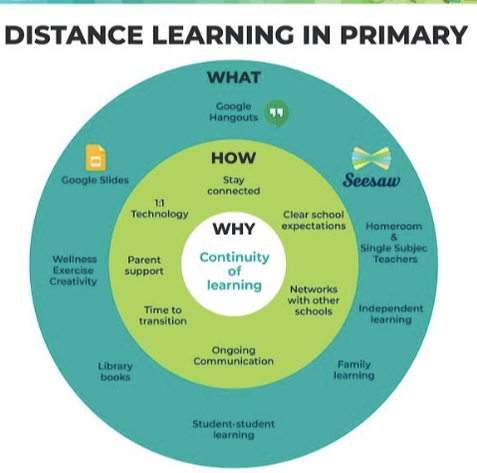
After our first week of Distance Learning (DL), I felt proud of our school's professionalism, commitment to learning and especially to the general wellbeing of our entire community (students, teachers, leaders and parents). Our team pulled together and worked hard to find solutions. The Learner Profile came alive in our staff. No-one on our team had previous experience with conducting DL sessions for primary students. Many of us have experienced DL as learners through the various professional development courses offered (i.e. online masters courses, IBO courses, etc.) but facilitating it is another issue entirely. Everyone demonstrated commitment, open-mindedness and risk-taking while relying on colleagues to support them along the way. Fortunately for our learning community, we were able to provide every student with a Macbook or iPad from school which helped us to avoid many potential issues with technology connections and software.

As COVID-19 began to spread slowly from China, our school took steps to begin preparations for launching a balanced DL program aligned not only to our mission and vision but also to 3 core values we identified as a team: continuity of learning, keep us connected as a learning community and make sure it both sustainable manageable for community wellbeing. After the first week of DL, we made adjustments for sustainability to our DL program expectations. Above all, this is one of the biggest take aways for me, the need for flexibility, growth mindset and the ability to think creatively and strategically about best practice teaching in the digital environment.

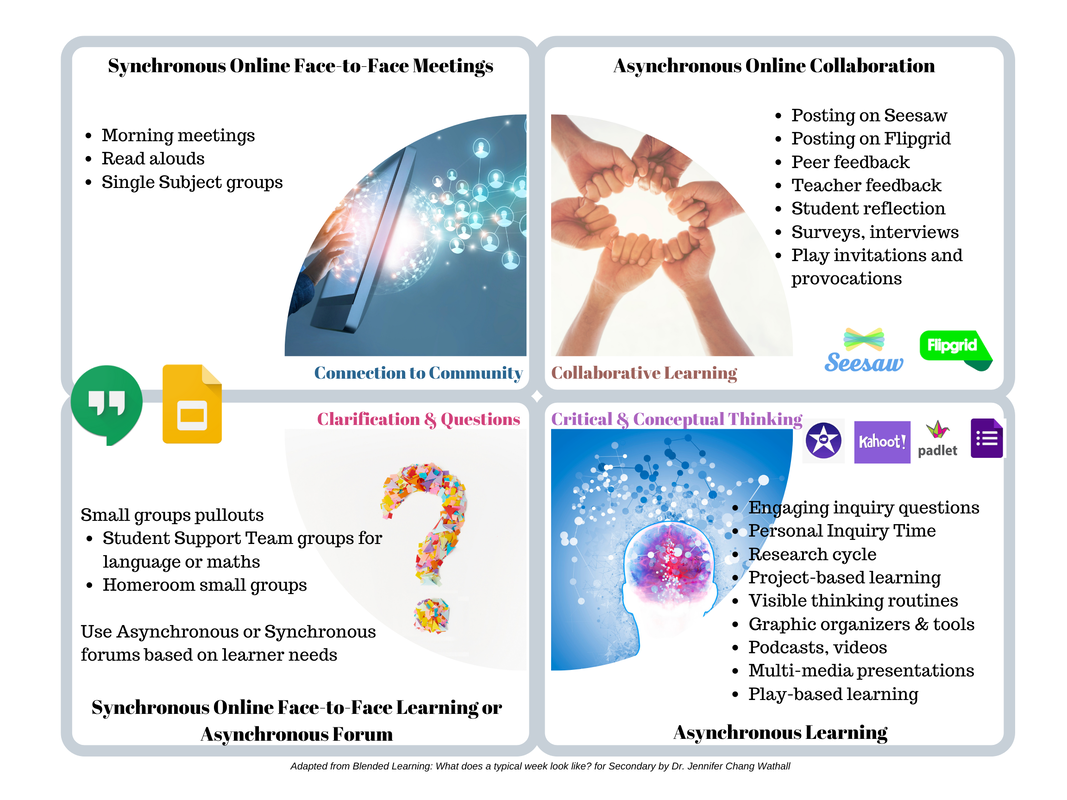
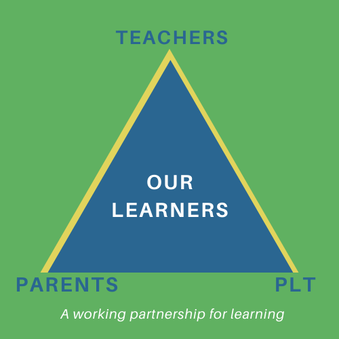
​Our learners are at the heart of the triangle; we seek to facilitate the learning and teaching so that our learners are successful in this new environment. This meant all hands on deck working to create content, learning new platforms and introducing students to an entirely different system for learning. Besides being involved in multiple meetings and joining grade level morning meetings on Google Hangouts, I made myself busy creating digital read aloud videos aligned to the current units of inquiry or to the approaches to learning, key concepts and learner profile of the IB PYP. Now I feel like a pro on iMovie. I've also learned how to ScreenCast. Next, I will be learning how to conduct a math group session on Google Hangouts while sharing my screen. So much to try and so much to learn, but I'm determined to figure it out and be successful so our students feel successful. 

Areas to consider for your program:
  • Child protection - ways to stay connected safely, limiting how we expose little ones to social media, digital citizenship
  • ​Wellbeing - providing creative ways to learn without screen-time (play-based learning, tinkering and maker ideas, forest school approaches; fostering the joy of reading); providing staff with time to unplug, rest and see to their wellbeing; getting the counselor involved with checking in on isolated international teachers
  • Community - sustain the sense of community through department and grade level check-in meetings with leadership; communicate consistently through morning messages from leadership; respond to emails as quickly as possible to ease anxiety and stress; schedule a staff get together in the virtual realm each week (happy hour)
  • Share the load - Encourage teaching teams to split up the disciplines/content; one takes mathematics/number, one take unit of inquiry and one takes literacy/language. Encourage Teaching assistants to get involved with giving feedback and monitoring student posts on Seesaw. Encourage staff to maximize their capacity to collaborate for their own wellbeing.
  • Consolidate learning over new material - perhaps focus on consolidating learning from past lessons at this time rather than introducing new material; focus on conceptual understandings and deepening them in mathematics, language and extending on inquiry skills;
  • Routines - supporting students in establishing a routine at home and a place to learn with all their materials easily accessible to them.
  • Schedule - a balance between synchronous and asynchronous learning engagements, a balance between school programming and allowing for flexibility at home to meet the demands of the family. 
  • Resources - provide key or strategic resources to staff for immediate launch (login list for paid sites, quick training sessions to up-skill, specific platforms to begin using first; tools for staff collaboration and communication); encourage learning support staff to support differentiation needs; prevent teachers from being flooded with resources that lead to lost time following rabbit holes
  • Framing the lessons - do not forget about the ways children learn (make the goal clear, access prior knowledge and provide context, provide new information, provide a means of application, and review the goal). I have always used Jane Pollack's approach to planning a lesson mentally in my mind; it is worthwhile considering her GANAG model as you facilitate digital lessons. See the lesson plan template below for reference.

Your browser does not support viewing this document. Click here to download the document.
2 Comments

    Author

    As an international educator, I work with colleagues in my local and global network regularly to implement inquiry through concept-based approaches to learning and teaching. It is a journey of discovery, learning and growing our own understandings about the ways children learn.

    Categories

    All
    Action Cycle
    Agency
    Approaches To Learning
    Beliefs
    Belonging
    Big Idea
    CBCI
    Cognitive Load
    Collaboration
    Collective Wellbeing
    Community
    Competent
    Comprehensible Input
    Concepts
    Conceptual Understandings
    Consent
    Contexts
    Continuous Provisions
    Creativity
    Curiosity
    Curriculum Mapping
    Distance Learning (DL)
    Documentation
    Education
    Equal Groups
    Equitable Education
    Equity
    Experiential Learning
    Feedback
    Generalizations
    Grit
    Image Of The Child
    Inclusion
    Inductive Learning
    Inquiry
    Inquiry Cycle
    Integration
    Interculturalism
    Interdisciplinary Learning
    International Mindedness
    Language Development
    Learning Panels
    Learning Transfer
    Mathematics
    Mindset
    Motivation
    Participation
    Peace
    Play
    Play-based Learning
    Playful Learning
    Play Invitations
    Play Provocations
    Portfolios
    PWIM
    Questioning
    Reflection
    Reggio Emilia Approach
    Relevant Learning
    Representation
    Selling The Why
    Shared Vision
    SIOP Method
    Social Construction
    Sustainability
    Sustainable
    UN 17 SDGs
    Values
    Wellbeing

    Archives

    January 2026
    October 2025
    May 2025
    June 2024
    March 2020
    August 2019
    April 2019
    March 2019
    February 2019
    January 2019
    November 2018
    April 2018
    March 2018
    December 2017
    November 2017
    October 2017
    September 2017

    RSS Feed

    View my profile on LinkedIn

    This website uses marketing and tracking technologies. Opting out of this will opt you out of all cookies, except for those needed to run the website. Note that some products may not work as well without tracking cookies.

    Opt Out of Cookies

Home

About

Services

Menu

Contact

Copyright © 2015
  • Home
  • Services
  • Free Resources
  • Blog
  • About
  • Contact