|
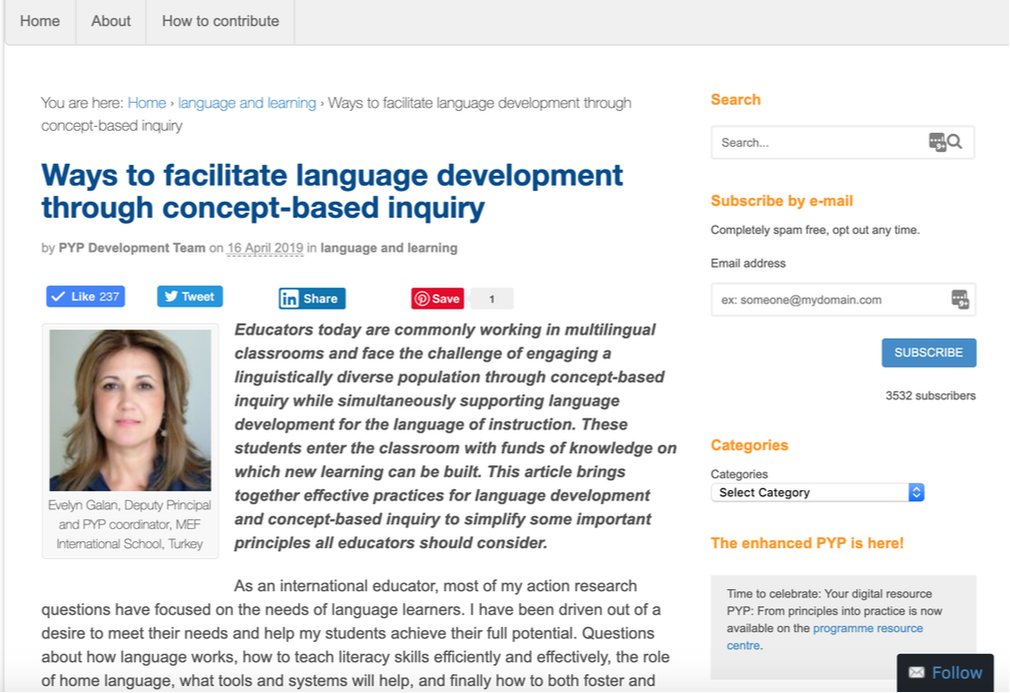
So proud to have an article on The SharingPYP Blog. I hope you have a chance to read it and learn from all the years of research it took to arrive at these understandings. UPDATE: January 3, 2026 Recently, I noticed my article no longer appears on Sharing the PYP Blog. I have added the content here for anyone interested. Ways to facilitate language development through concept-based inquiry As an international educator, most of my action research questions have focused on the needs of language learners. I have been driven out of a desire to meet their needs and help my students achieve their full potential. Questions about how language works, how to teach literacy skills efficiently and effectively, the role of home language, what tools and systems will help, and finally how to both foster and capture conceptual understandings drove me to read, research and attend professional development courses. Through research I have discovered a few fundamental learning principles that are relevant to all international educators no matter the context or language of instruction. These learning principles can positively impact the learning for all students. Conceptual understandings can both deepen and become visible to the learning community. Their self-efficacy and sense of agency will grow as they reflect on learning that was relevant, engaging and comprehensible. Principle 1 – Give sufficient time for exploration through experiential learning. Use it for pre-assessment, to identify misconceptions, to draw out questions and to cultivate curiosity while making language development relevant. Piaget and Vygotsky have shown that learning is constructed through tangible, concrete, social experiences (Woolfolk, 2014). The more concrete, hands-on experiences our students can have throughout the unit of inquiry, especially in the first couple of weeks, the more powerful and meaningful the inquiry will be for them (Fahey, 2012). Using concrete learning experiences fosters language development by making the content comprehensible (Hamza, 2016). It makes learning tangible, which in turn fosters the curiosity needed for questioning. Through experiential exploration, students can make connections to their funds of knowledge, and identify relevant local issues alongside deepening questions for the investigation stage (Custance, Dare and Polias, 2012). During Where we are in place and time, our central idea was about settlements and landforms. Through research, I discovered scripted process drama (Barnes, Johnson & Neff, 2010). After giving my students time to cultivate some curiosity through listening to short stories read aloud, listening to guest speakers share stories about migration, observing pictures of early settlements and a field trip to the Citadel, I was able to facilitate the scripted process drama to engage their imagination, pre-assess understandings and draw out some questions for our investigation such as:
“We learned how people in the past, they were working to get water and food to survive. They need a home and wood to make a home.” Principle 2 – The learning environment as the third teacher is where learning takes place and should be a stimulating, anxiety free space where mistakes are seen as opportunities and where the voice of the child is heard as a social environment. Foster a learning environment that meets the students where they are and cultivates a culture of curiosity, growth mindset and social construction of ideas within their zone of proximal development (Dweck 2016; Woolfolk, 2014). The environment should honor their learning and provide resources to make learning accessible. According to Loris Malaguzzi, the learning environment is the third teacher as it represents our values and beliefs about children, delivering the unspoken messages about children’s rights (Edwards, Gandini, & Forman, 1998). John Dewey wrote about the power of an environment and its role in social function for bringing about change and social improvement over perpetuating the old behaviors that benefit a few (2015). Value home identity and culture through the strategy of translanguaging to foster understandings by using home language to make meaning at critical times (Garcia & Kleyn, 2016). Make home language welcome in the classroom from the first day of school by honoring the child’s identity through language profiles. Translanguaging used thoughtfully, at critical learning moments enables students to converse in their home language to make meaning (Garcia, & Kleyn, 2016). Use the think-pair-share strategy for a translanguaging moment. Visual scaffolding connects pictures with text for meaning making (Harrel, & Jordan, 2015). The environment in my classroom became a visible language rich resource and my students could easily refer to the displays to support making connections and language needs.
To foster a social learning environment, recognize that all learners benefit from time to learn together as a whole group through modeled thinking and instruc-tion, in small groups and in pairs (Custance et al, 2012). Students need oppor-tunities to deconstruct things such as a genre or process and to construct as a whole group and in small groups before you can expect them to try it alone (Custance et al, 2012). That is why transdisciplinary learning is so beneficial for the inquiry-based classroom. Language reading and writing skills can be taught and developed throughout the inquiry process within a relevant context as they learn to read and write about what they are learning through the transdiscipli-nary theme. Integrating the targeted genre via the summative assessment task, gives the genre context for meaningful engagement with the language strands (IB, 2018). Below are some examples of genre integration:
Principle 3 – Explicitly teach, model and construct generalizations together throughout the inquiry process. Give more time for thinking and synthesizing
Hattie and Yates suggest that concepts serve as mental ‘coat hangers’ allow our students to organize their learning to make sense of it (2014). Just as we take the time to explicitly model and teach literacy or mathematics processes and skills, it is essential to teach and model the skill to make generalizations. ‘Generate-Sort-Connect-Extend’ is an example of a visible thinking strategy that encourages students to make connections between concepts by drawing a line to connect concepts and identifying a new generalization (Ritchart et al, 2011). It extends the concept map to facilitate transfer. Hexagonal thinking is another way for students to organize their learning visually and then create generalizations to state why the concepts are connected to each other. The PYP approaches to learning now include the skill of ‘information transfer,’ which recognizes our role in facilitating transfer (IB, 2018). There are many tools that you can use to help students make connections to the concepts while also making their thinking visible to the learning community. Begin to explore this area of instruction. Our language learners can participate in concept-based inquiry while learning a second or third language if the supports are in place. Language learners develop understandings and language simultaneously when provided the support, tools and a language rich environment.
References Barnes, M. K., Johnson, E. C. and Neff, L. (2010). Learning through process drama in the first grade. Social Studies and the Young Learner 22 (4) 19-24. Custance, B., Dare, B. and Polias, J. (2012). Teaching ESL in the mainstream: language and learning across the curriculum, 3rd ed. South Australia: DECD Publishing Dewey, J. (2015). John Dewey: The collected works of John Dewey [Kindle edition]. PergamonMedia. Dweck, C. S. (2016). Mindset: The new psychology of success. New York, NY: Random House. Edwards, C., Gandini, L., and Forman, G. (1998). The hundred languages of children: The Reggio Emilia approach – advanced reflections, 2nd ed. Westport, CT: Ablex Publishing. Erickson, H. L. (2007). Concept-based curriculum and instruction for the thinking classroom. Thousand Oaks, CA: Corwin Press. Fahey, J. (2012). Ways to do inquiry: Guiding children to deeper understanding. Cardiff: IBO Garcia, O. and Kleyn, T. (2016). Translanguaging with multilingual students: Learning from classroom moments. New York, NY: Routledge. Halliday, M.A.K. & Webster, J. J. (2016). Aspects of language and learning, 1st ed. Sydney, NSW: Springer. Harrel, A. L. and Jordan, M. (2015). 50 strategies for teaching English language learners, 5th ed. Boston, MA: Pearson. Hattie, J. and Yates, G. C. R. (2014). Visible learning and the science of how we learn. New York, NY: Routledge. Hagemans, M. G., van der Meij, H., & de Jong, T. (2013). The effects of a concept map-based support tool on simulation-based inquiry learning. Journal of Educational Psychology, 105(1), 1-24. doi:10.1037/a0029433 IBO, 2018. Learning and teaching. Cardiff, Wales: Peterson House. Murdoch, K. (2015). The power of inquiry. Northcote, Vic: Seastar Education. Ritchart, R., Church, M., and Morrison, K. (2011). Making thinking visible: How to promote engagement, understanding, and independence of all learners. San Franscisco, CA: Jossey-Bass William, D. (2011). Embedded formative assessment. Bloomington, IN: Solution Tree Press. Woolfolk, A. (2014). Educational psychology: Active learning addition, 12th ed. Boston, MA: Pearson. Hamza, T. [Tarek Hamza]. (2016, Jan 28). Stephen Krashen: Language Acquisition and comprehensible input. Retrieved from: https://www.youtube.com/watch?v=fnUc_W3xE1w. Van de Walle, J., Lovin, L. H., Karp, K. S., and Bay-Williams, J. M. (2014 ). Teaching student-centered mathematics: Developmentally appropriate instruction for grades pk-2, Vol. 1, 2nd ed. New York, NY: Pearson. AuthorEvelyn Hargett Galan has 15 years’ experience working in international education having lived in five different countries. She currently works as an international educator currently serving as the Deputy Principal/PYP Coordinator at MEF International School in Istanbul, Turkey. She is a certified Concept-Based Curriculum and Instruction (CBCI) workshop leader. Previously she was a homeroom teacher in an IB PYP multilingual school in Erbil, Iraq teaching grade 2 as well as facilitating ESL in the Mainstream workshops for the faculty. Evelyn began her career in international education in Cancun, Mexico where she served as English Coordinator and homeroom teacher in a bilingual school over a period of 11 years. She has earned a Master of Arts in Teaching and most recently a Master of Arts in Education with an accompanying certificate as an IB Educator. Working with language learners throughout her entire career in education has taught her to seek out best practice strategies in order to meet the learning needs of her students and to support the needs of her colleagues.
0 Comments
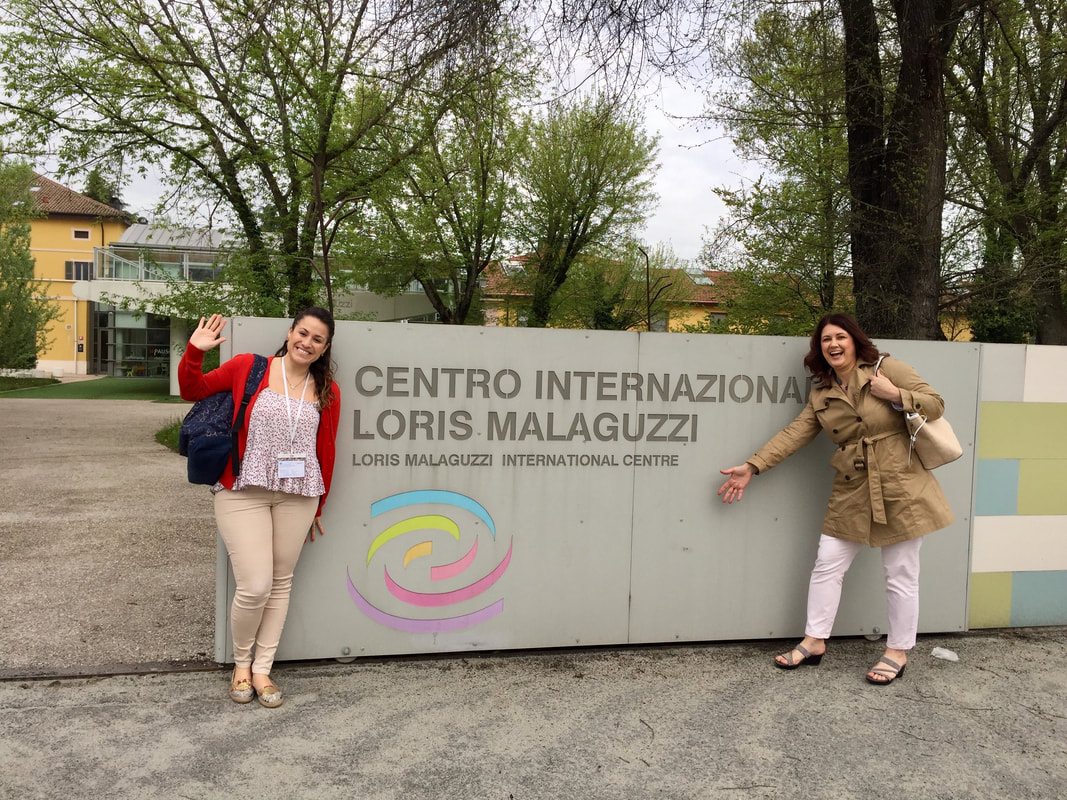
Upon a visit to Reggio Emilia, Italy
When I first learned about Reggio Emilia’s approach to learning, I was forming my research questions for my final Action Research project to conclude an M.Ed. at George Mason University. I was interested in finding a variety of ways to capture the conceptual understandings of my students who had not developed sufficient English language ability to express themselves, as they would have liked. My professor recommended that I check out the work of Loris Malaguzzi and The Hundred Languages of the Child. The deeper I delved into the resources I found about the municipality of Reggio Emilia and its approach to learning, the more I wanted to be a participant in an International Study Group. This April, I was able to attend along with one of our ECC teachers and what an inspiring experience it was for us both. Values and Beliefs We saw the positive impacts of the goals set by the community of Reggio Emilia back in the late 1940’s at the close of World War II; goals to build a community that created new identities and new rights for women and children. This was based on a series of choices; cultural, ethical and political in nature. These goals were intended to foster community participation and innovation in education to make the child a priority in order to build a positive, respectful community for the present and future. A new life, a new way, new values and a new community by committing to the commons, values for the common good.
Positive Impacts As the school I’m working at is currently walking through a combined CIS/NEASC self-study, our staff is in in the process of re-evaluating our mission, vision, beliefs about learning and teaching and the roles we play as leaders and teachers. We are searching for the impacts of our endeavors, reflectively searching for evidence and pondering actions we might take. Have we achieved our mission? Are we on the road to achieving our vision? These are big questions and require a lot of thought. This experience at Reggio Emilia enabled to me to see concretely what it looks like when a school system and the community work together to achieve their goals out of a common vision and commitment . The people of Reggio Emilia that I encountered were caring, respectful and helpful. They have a multitude of programs to reach children (0-12th), the elderly and for interaction between all age groups. Their annual municipality budget sets aside 13% for the early years programs. This community reaches out and welcomes visitors, immigrants (17%) and anyone who engages with their community. Visible Learning One strong value of the Reggio Emilia educational project was to make visible the educational contexts and children’s learning inside the schools and outside in the community. Learning is visible wherever one looks in the early childhood centers and schools. The materials and partially constructed projects left accessible in the ateliers, piazzas and classrooms show the thinking and understandings that are forming. The learning panels published and posted on the walls demonstrate the pedagogy (why), the process (how) and the conceptual understandings (what) the students have developed as a result of the progezzione (project). Publications are produced annually about the projects completed and gifted to parents. Projects are shared with the community in a variety of creative ways. Participation Parents are welcomed into the schools to demonstrate the value of participation. They are encouraged to come into the piazza, casually drop their children and chat with teachers about life to pass along important information or ask questions. The face-to-face interactions are highly valued and emails are avoided. Parents elect leaders to work alongside the teachers to promote learning and participation within the community. They can suggest field trips and assist with projects while in process and in the publication or presentation of projects to the community. We had the opportunity to learn about two very important projects: the rights of the child and the hospital through the lens of the child. Both projects involved the community and resulted in action that impacted the community positively. Why? The community used the children’s ideas to publish and display these rights in all the schools as well as to make them available to the public through buttons and postcards. At the hospital, the children decided to gift their thoughts to make the hospital more welcoming. These thoughts were organized and artistically displayed by the Reggio Emilia atelieristas. Now patients in the hospital can get some respite from their fears by reading the thoughts of the children, thoughts that provoke smiles. Learner and Teacher Agency The PYP is releasing enhancements to update their framework and align it to the current research on learning and teaching. There is a new focus on agency and the learner’s voice, choice and ownership. I’ve been pondering this as I wondered what it looked like in action as well as what shifts our staff would have to make to say we both value and empower agency. The teachers of Reggio Emilia value the child to the extent that is agency in action; it is embedded in their practice. They listen to the voice and ideas of the child, documenting the learning process and thoughts through pictures and anecdotal notes. The documentation guides the decisions about learning. It is visible in the centers on clipboards, binders and portfolios. Teachers are knowledgeable about childhood development; stages of development and take research seriously but do not allow that knowledge to limit their ability to personalize the education for their students. They do not categorize their students into developmental boxes. It does not become a barrier. They honor and respect the child and the fact that each child is unique. All decisions appear to stem from their values and beliefs about the child. They allow their students to develop strategies for finding knowledge and support them throughout the process within their zone of proximal development. They allow their students to spiral back to what they know naturally as they attempt to spring to a new level of development. Teacher agency is visible through the professional development time they use to collaboratively discuss their experiences each week about the learning that is happening. They work together to overcome difficulties, challenges and find the best way to respond to the ideas and thoughts of the children as they thoughtfully steer the projects through provocations, discussions, reflections and time for experimenting. They work together to consider ways to re-launch a project that may have stalled slightly and continue extending the project to build new understandings. This belief statement resounded with me deeply, “I learn with you and you learn with me.” It is an atmosphere that does not value hierarchy but rather cooperation and collaborative reflective practice. Creativity, Motivation and Curiosity In this environment, creativity abounds. The walls and displays are student made. Beauty is everywhere. It is fostered and the children’s innate need to make things beautiful is honored. I never saw any child bored or acting out. The environment was relaxed, not tied to a rigid schedule, but allowing children the freedom and time to explore their curiosity. Children actively engage in projects for extended periods of time. The content is relevant and is founded in questions the children have so their interest is peeked. They investigate answers through concrete experiences with materials, field trips and experiments. Technology is a tool that is used when they find themselves unable to solve problems without it. The environment is rich with materials and places to explore the answers to their questions. They foster creativity by pursuing creativity themselves. At Reggio Emilia, collegiality is the key to sustaining creativity. The teachers read about it, surround themselves with creative materials, attend museums and art exhibits. They discuss ideas together and allow ideas to flow uninhibited. The children are their allies in creativity and are prompted to join in the discussion. Tips from Reggio Emilia:
Dreams and Goals Now that I have had this experience, I am pondering ways to share my experience with my colleagues; an experience that left me profoundly impacted. I consider the ways we as a team can change the way we see our roles to minimize the hierarchy and increase the amount of collaboration for the benefit of all stakeholders. I’m excited about the shifts in the PYP and can now visualize learner agency (students and teachers). Together we can explore more deeply what that means for our students, parents and to each of us personally. We can reimagine learning and work to increase participation of all – our students, our parents, our teachers, our support staff and our leadership team. I wish to experience that value and idea of professional development….”I grow with you and you grow with me.” and I look forward to exploring ways to make my beliefs about the child visible to our community alongside my colleagues. |
AuthorAs an international educator, I work with colleagues in my local and global network regularly to implement inquiry through concept-based approaches to learning and teaching. It is a journey of discovery, learning and growing our own understandings about the ways children learn. Categories
All
Archives
March 2026
This website uses marketing and tracking technologies. Opting out of this will opt you out of all cookies, except for those needed to run the website. Note that some products may not work as well without tracking cookies. Opt Out of Cookies |
RSS Feed