THINK BEYOND THE FACTS, THINK CONCEPTUALLY
  • Home
  • Services
  • Free Resources
  • Blog
  • About
  • Contact

Concepts in Action

How we build capacity for conceptual thinking through PLAY: A focus on the Early Years Team

5/12/2025

0 Comments

 
Picture
When we opened Brewster Madrid, I shared a vision for a community of learners who worked together efficiently and effectively so that everyone felt supported. This was how I envisioned achieving our mission to see that every learner of all ages thrived. By establishing a Lower School on the idea of relationships before program, and communicating a strong sense of shared ownership for the learning and teaching process, I was able to guide our team to fully implement systems for learning, teaching and assessment.

In July 2023, I introduced our founding Lower School team to the principles of Concept-Based Curriculum and Instruction (CBCI) based on the works of Drs. Erickson and Lanning. As an Erickson & Lanning CBCI certified trainer, I used our Brewster Summer Institute (BSI) to begin making conceptual teaching and learning accessible to our team. We started with establishing an initial understanding of the role of generalizations, their structure and levels or depth of understanding. Generalizations serve as an assessment tool from which we can respond to through scaffolding the thinking process. This impacts our planning process. When there is an intention to harvest generalizations, the planning process needs to change so that can become a reality.

These themes formed the foundations for our deep dive into inquiry-based learning for conceptual understanding. Every teacher received a copy of Carla Marshall and Rachel French's book, Concept-Based Inquiry in Action: Strategies to Promote Transferable Understanding. Our school joined the Concept-Based Inquiry Mathematics (CBIM) pilot project to begin to dive into CBI through the lens of mathematics. My hope was that this participation would support teacher understandings over time of how the inquiry cycle works, and the intentions behind its design. By the second year, under the guidance of our NEASC visitors, we established Concept-Based Inquiry (CBI) as our first pedagogical anchor, the pedagogy that we would see in action daily. This anchor became one of 4 anchors:
  1. Concept-Based Inquiry
  2. Approaches to Learning
  3. Progress Monitoring & Reflection
  4. Inclusive Classroom (UDL & Differentiation)

Our Early Years program, while inspired by the pedagogy of play, honors the principles of CBCI. We know our early learners can be thinkers. They can think about their play and express understandings as emerging communicators. Between 2023-2025, our team came to in-service training days with open-minds, carefully and thoughtfully considering the concepts of play, space, playful (more teacher-led) and play-based learning. Through reflection, we continually unpacked the ways in which we can plan for play: 
  • play invitations
  • play provocations
  • continuous provisions 
There were ongoing discussions about the documentation of what was observed for learner ownership, participation, reflection and parental involvement.
  • the hard copy portfolio - intended to be student-led
  • the digital Toddle portfolio - parent involvement and feedback
  • the documentation on the walls and bulletin boards - teacher- and student-led
During planning meetings, we slowly unpacked the ideas behind play-based learning endeavoring to elaborate an evolving Philosophy of Play personalized to our learning program. We want a program where we can follow and respond to the developmental needs of the child. This means introducing them to literacy and numeracy concepts when they demonstrate readiness - knowing our learners well to keep them challenged.

The tension lies between our need to be teachers (i.e. to teach phonemic awareness, phonics, the elements of a story) and play without reconciling what that can look like through play. The tensions are real! As teachers learn to facilitate play there is a struggle to identify their role. And it is through patience and ongoing support that each teacher can find the space to wrestle with their individual tensions and explore ways to employ continuous provisions for symbolic exploration and expression. I am thrilled with how far our team has come in their understandings. We have high hopes for program as we continually unpack the needs of our learners and their development.

Progress Monitoring & Reflection
There was a lot of mental tug of war as our team began to dive into the UK Birth to 5 Matters with increasing intention to make sense of those developmental parameters and align those with the observable skills identified in the PYP Early Years Approaches to Learning. We wanted to build an understanding of the two documents so that we could document what we saw, speak to developmental progress based on observations in alignment with stages and help parents understand how learning happens through play. An ongoing project, we continue to consider are the Approaches to Learning and their connection with Birth to 5 Matters for developmental growth tracking. We currently are pondering these questions:
  • What tools will help us track learner development efficiently?
  • How can we organize the information in those documents for accessibility?
  • How can we track development to guide our play plans such that both students and parents are aware of the developmental progress we observe?

Picture
Picture
Picture

Our Documentation Journey

Over these two years, our EY team's curiosity about how to plan for play while making connections to our units of inquiry has led us to dialogues about process, efficiency and learner agency. We aimed to document learning in a way that our learners can connect to their contributions. We also wanted our parents and families to feel connected and informed through our Toddle digital portfolios. It can become overwhelming if we don't find the right approach.
  • By creating Walls of Understandings, we can share the learning story with our families and make the learning visible to our community.
  • Through group learning stories, we can communicate our observations about early childhood development: the emerging knowledge and skills, the approaches to learning and the whole child's physical development.
  • The individual hard copy portfolio become places to store the artifacts chosen by the learners. It is accessible to the child to peruse and reflect on. And its relevance will grow over time as they build connections to tracking their learning journey over time.
Picture
This image represents a CBI approach to How the world works: Construction, so much risk-taking enriched with teacher and learner curiosity, supported by a caring persistent learning environment. Together we learn and grow!

Outdoor Play Challenges

In August 2023, outdoor play presented a challenge for our team as we lacked sufficient equipment and storage. As a new school, we had not been able to participate in planning the outdoor spaces. When we saw what had been organized by the architect, we were uncertain of how to create a welcome space for all ages. The equipment selected was limited, lacking the ability to develop strength and the vestibular system (equilibrium, balance). We were overwhelmed by what we lacked: a mud kitchen, creative play spaces and a storage shed to teach our learners how to care for the equipment for sustainability. It was difficult to make the space stimulating and engaging. Unintentionally, we found ourselves focussed on controlling the play area with lots of rules and increasingly eliminating risky play opportunities.
Protected cement blocks that we could not move. The school also did not want to pay a crane to move them.
This slide was not on the original plans. The wall was missing the climbing elements and rope.
Stairs down to the court
August 2023: Cement court that was later covered by astroturf and dirt because the Heritage Society cancelled our lower court pitch plans. All had to be returned to natural spaces.
August 2024: The next stage, covering the playground with dirt to make it look more natural. By January, green astroturf was laid down over the dirt but the dirt kept seeping through.
Two seesaws...
Few were attracted to these...
A climbing structure that did not allow for strength building or balancing. Too small to achieve much...
Temporary soccer nets that broke within a month...
Old picnic tables and lots of rocks...
Left over stones and cables...
Through collaboration with the facilities team and our senior leadership, we were able to get some equipment built. Using the discarded pallets, Juan Carlos built us a mud kitchen, three mini-markets, benches and a mark-making house. These additions began to transform the play though we still lacked the storage to maximize the spaces and the Tuff trays. Most of the equipment was getting abused and worn out by the rocks and the type of dirt we had. We prepared a space for digging dirt to be delivered but was unable to get that approved due to the shortfalls in the budget. 

Our play consultant, Duane Smith, offered the teachers advise on ways to use what we had access to through a continuous provisions approach. By responding to the play observed, teachers can stage the play before children arrive. This system took time for our team to adapt to and slowly, slowly, all this equipment began to shift and move locations. We realized the Tuff Tables needed to be far away from the rocks and mud so that they could be used for blocks and other play invitations. We moved the mark-making table out of the garden and onto the patio to put chairs around it for reading and drawing outside. We saw the children building fairy houses in the trees, using their imaginations creatively.

Planning forward with a significant increase in enrollment for September 2025, we were targeting more didactic materials for outdoor play including oversized blocks, tools for building ramps, large outdoor games, and a new mud kitchen to make sure all children could find materials and something to draw their curiosity. Because of the heritage building, getting swings requires more permitting. Over time, there is hope to replace the seesaws with open space for more flexibility. And to remove the equipment in the sandpit. There is hope to have that in place within a year or two.
Our mud kitchen and Tuff Trays (you can see are full of mud)
Two more markets, a bench and picnic tables. These eventually moved closer to the mud kitchen.
Our garden - it has to be raised and fenced in as it was for the whole school garden club. We wanted to keep the rabbits out!
The back side of the market. What can we use the backside for?
Mark-making table - painted with black chalk paint
In January 2025, we finally got a storage shed installed. It was exciting to organize it so that we could begin teaching the children how to care for their play materials. We wanted to find the way to allow for full access with our learners practicing care and responsible choices.

Resources of Inspiration

Picture
Picture
Our greatest resource was found in our consultant, Duane Smith of Early Learning in Education, who carries a full career heavily invested in the early years teaching and learning. We consulted with Duane in the second year of the school and program launch. He spoke from experience building immediate rapport and igniting curiosity from our EY team. He inspired our entire team to rethink how we defined play, how we used the spaces and to challenge our team to provide for a wide variety of childrens' play needs through continuous provisions.


Picture
Harvard Project Zero's Pedagogy of Play

Picture
Resources and books published by Reggio Children from my visit there to demonstrate documentation, creativity and the impacts of play-based learning.

Picture
We were able to pay for one teacher to take this online course with Dr. Jo Fahey at Professional Learning International.
Picture
The UK Birth to 5 Matters Scope and Sequence - A developmental approach to supporting and tracking early childhood development skills for learning

Picture
Throughout year 2, we began diving into our learner's need to have access to risky play. This remains an ongoing inquiry...
Picture
See MyIB for access to this and other resources on approaches to play in the Early Years.

Picture
Rusty's use of space, nature and loose parts for play, including rough & tumble play... inspired us to continue reimagining our spaces and materials.

0 Comments

Reggio Emilia, A Community of Learners

4/30/2018

1 Comment

 
Picture
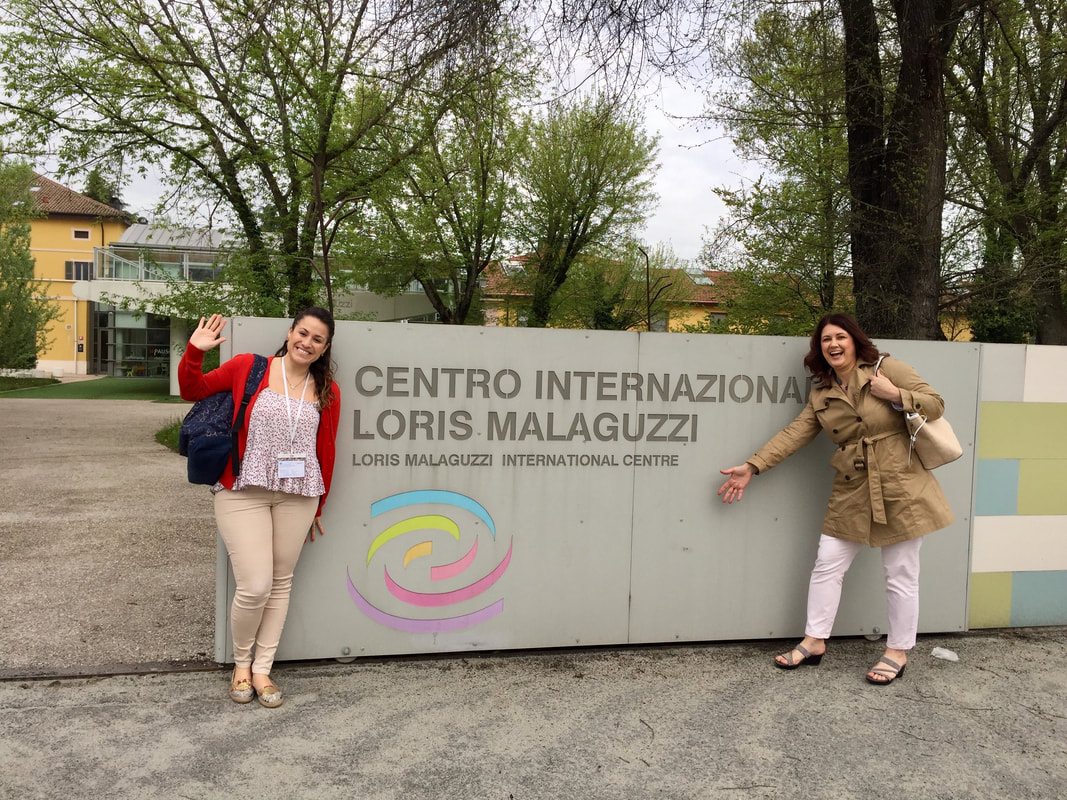
Upon a visit to Reggio Emilia, Italy
When I first learned about Reggio Emilia’s approach to learning, I was forming my research questions for my final Action Research project to conclude an M.Ed. at George Mason University. I was interested in finding a variety of ways to capture the conceptual understandings of my students who had not developed sufficient English language ability to express themselves, as they would have liked. My professor recommended that I check out the work of Loris Malaguzzi and The Hundred Languages of the Child.  The deeper I delved into the resources I found about the municipality of Reggio Emilia and its approach to learning, the more I wanted to be a participant in an International Study Group. This April, I was able to attend along with one of our ECC teachers and what an inspiring experience it was for us both.  
 
Values and Beliefs
We saw the positive impacts of the goals set by the community of Reggio Emilia back in the late 1940’s at the close of World War II; goals to build a community that created new identities and new rights for women and children. This was based on a series of choices; cultural, ethical and political in nature. These goals were intended to foster community participation and innovation in education to make the child a priority in order to build a positive, respectful community for the present and future. A new life, a new way, new values and a new community by committing to the commons, values for the common good.

  • Education is a right and responsibility of all and must be available to all
  • Relationships – between the schools and the municipality, the families and the schools, the children and their teachers
  • A New Image of the Child – a skilled child, building competence through relationships, who enjoys challenges, creating beauty and constructing knowledge through testing, observing and interacting with the world around them. A child full of ideas and thoughts to be honored.
 
Positive Impacts
As the school I’m working at is currently walking through a combined CIS/NEASC self-study, our staff is in in the process of re-evaluating our mission, vision, beliefs about learning and teaching and the roles we play as leaders and teachers. We are searching for the impacts of our endeavors, reflectively searching for evidence and pondering actions we might take. Have we achieved our mission? Are we on the road to achieving our vision? These are big questions and require a lot of thought.
 
This experience at Reggio Emilia enabled to me to see concretely what it looks like when a school system and the community work together to achieve their goals out of a common vision and commitment . The people of Reggio Emilia that I encountered were caring, respectful and helpful. They have a multitude of programs to reach children (0-12th), the elderly and for interaction between all age groups. Their annual municipality budget sets aside 13% for the early years programs. This community reaches out and welcomes visitors, immigrants (17%) and anyone who engages with their community.
 
Visible Learning
One strong value of the Reggio Emilia educational project was to make visible the educational contexts and children’s learning inside the schools and outside in the community. Learning is visible wherever one looks in the early childhood centers and schools. The materials and partially constructed projects left accessible in the ateliers, piazzas and classrooms show the thinking and understandings that are forming. The learning panels published and posted on the walls demonstrate the pedagogy (why), the process (how) and the conceptual understandings (what) the students have developed as a result of the progezzione (project). Publications are produced annually about the projects completed and gifted to parents. Projects are shared with the community in a variety of creative ways.
 
Participation
Parents are welcomed into the schools to demonstrate the value of participation. They are encouraged to come into the piazza, casually drop their children and chat with teachers about life to pass along important information or ask questions. The face-to-face interactions are highly valued and emails are avoided. Parents elect leaders to work alongside the teachers to promote learning and participation within the community. They can suggest field trips and assist with projects while in process and in the publication or presentation of projects to the community.
 
We had the opportunity to learn about two very important projects: the rights of the child and the hospital through the lens of the child. Both projects involved the community and resulted in action that impacted the community positively. Why? The community used the children’s ideas to publish and display these rights in all the schools as well as to make them available to the public through buttons and postcards. At the hospital, the children decided to gift their thoughts to make the hospital more welcoming. These thoughts were organized and artistically displayed by the Reggio Emilia atelieristas. Now patients in the hospital can get some respite from their fears by reading the thoughts of the children, thoughts that provoke smiles.
 
Learner and Teacher Agency
The PYP is releasing enhancements to update their framework and align it to the current research on learning and teaching. There is a new focus on agency and the learner’s voice, choice and ownership. I’ve been pondering this as I wondered what it looked like in action as well as what shifts our staff would have to make to say we both value and empower agency.
 
The teachers of Reggio Emilia value the child to the extent that is agency in action; it is embedded in their practice. They listen to the voice and ideas of the child, documenting the learning process and thoughts through pictures and anecdotal notes. The documentation guides the decisions about learning. It is visible in the centers on clipboards, binders and portfolios.
Teachers are knowledgeable about childhood development; stages of development and take research seriously but do not allow that knowledge to limit their ability to personalize the education for their students. They do not categorize their students into developmental boxes. It does not become a barrier. They honor and respect the child and the fact that each child is unique. All decisions appear to stem from their values and beliefs about the child. They allow their students to develop strategies for finding knowledge and support them throughout the process within their zone of proximal development. They allow their students to spiral back to what they know naturally as they attempt to spring to a new level of development.
 
Teacher agency is visible through the professional development time they use to collaboratively discuss their experiences each week about the learning that is happening. They work together to overcome difficulties, challenges and find the best way to respond to the ideas and thoughts of the children as they thoughtfully steer the projects through provocations, discussions, reflections and time for experimenting.  They work together to consider ways to re-launch a project that may have stalled slightly and continue extending the project to build new understandings. This belief statement resounded with me deeply, “I learn with you and you learn with me.” It is an atmosphere that does not value hierarchy but rather cooperation and collaborative reflective practice.
 
Creativity, Motivation and Curiosity
In this environment, creativity abounds. The walls and displays are student made. Beauty is everywhere. It is fostered and the children’s innate need to make things beautiful is honored. I never saw any child bored or acting out. The environment was relaxed, not tied to a rigid schedule, but allowing children the freedom and time to explore their curiosity. Children actively engage in projects for extended periods of time. The content is relevant and is founded in questions the children have so their interest is peeked. They investigate answers through concrete experiences with materials, field trips and experiments.  Technology is a tool that is used when they find themselves unable to solve problems without it. The environment is rich with materials and places to explore the answers to their questions.
 
They foster creativity by pursuing creativity themselves.  At Reggio Emilia, collegiality is the key to sustaining creativity. The teachers read about it, surround themselves with creative materials, attend museums and art exhibits. They discuss ideas together and allow ideas to flow uninhibited.  The children are their allies in creativity and are prompted to join in the discussion.
 
Tips from Reggio Emilia:
  • Creativity comes from your hands; you have to get your hands dirty and use your hands so play with the concepts, materials and tools you’re offering your students
  • When you fall in the love with the materials you’re offering the children, they will find it fun, also.
  • Feed creativity by surrounding yourself with creative materials, visiting exhibitions and participating in cultural experiences
  • Challenge yourself to change your perspective – look at the world around you differently
 
Dreams and Goals  
Now that I have had this experience, I am pondering ways to share my experience with my colleagues; an experience that left me profoundly impacted. I consider the ways we as a team can change the way we see our roles to minimize the hierarchy and increase the amount of collaboration for the benefit of all stakeholders. I’m excited about the shifts in the PYP and can now visualize learner agency (students and teachers). Together we can explore more deeply what that means for our students, parents and to each of us personally. We can reimagine learning and work to increase participation of all – our students, our parents, our teachers, our support staff and our leadership team.
 
I wish to experience that value and idea of professional development….”I grow with you and you grow with me.” and I look forward to exploring ways to make my beliefs about the child visible to our community alongside my colleagues.
1 Comment

    Author

    As an international educator, I work with colleagues in my local and global network regularly to implement inquiry through concept-based approaches to learning and teaching. It is a journey of discovery, learning and growing our own understandings about the ways children learn.

    Categories

    All
    Action Cycle
    Agency
    Approaches To Learning
    Beliefs
    Big Idea
    CBCI
    Cognitive Load
    Collaboration
    Collective Wellbeing
    Competent
    Comprehensible Input
    Concepts
    Conceptual Understandings
    Contexts
    Continuous Provisions
    Creativity
    Curiosity
    Curriculum Mapping
    Distance Learning (DL)
    Documentation
    Education
    Equal Groups
    Equitable Education
    Equity
    Feedback
    Generalizations
    Grit
    Image Of The Child
    Inductive Learning
    Inquiry
    Inquiry Cycle
    Integration
    Interculturalism
    Interdisciplinary Learning
    International Mindedness
    Language Development
    Learning Panels
    Mathematics
    Mindset
    Motivation
    Play
    Play-based Learning
    Playful Learning
    Play Invitations
    Play Provocations
    Portfolios
    PWIM
    Questioning
    Reflection
    Reggio Emilia Approach
    Relevant Learning
    Selling The Why
    SIOP Method
    Social Construction
    Sustainability
    Sustainable
    UN 17 Sustainable Goals
    Values
    Wellbeing

    Archives

    October 2025
    May 2025
    March 2020
    August 2019
    April 2019
    March 2019
    February 2019
    January 2019
    November 2018
    April 2018
    March 2018
    December 2017
    November 2017
    October 2017
    September 2017

    RSS Feed

    View my profile on LinkedIn

    This website uses marketing and tracking technologies. Opting out of this will opt you out of all cookies, except for those needed to run the website. Note that some products may not work as well without tracking cookies.

    Opt Out of Cookies

Home

About

Services

Menu

Contact

Copyright © 2015
  • Home
  • Services
  • Free Resources
  • Blog
  • About
  • Contact