THINK BEYOND THE FACTS, THINK CONCEPTUALLY
  • Home
  • Services
  • Free Resources
  • Blog
  • About
  • Contact

Tools for Conceptual Thinking

Picture
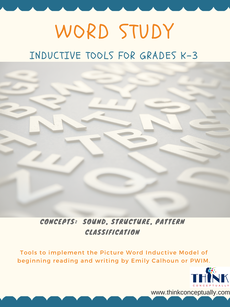
Word Study Tools Using PWIM by Emily Calhoun

As a homeroom teacher in an international school environment, I have found that integrating this model of teaching is highly effective for teaching beginning reading and writing as well as for inquiry-based word study. Not only that, it integrates visual scaffolding for language learners and allows students to have a visual dictionary for the words they are sorting. I have developed several tools for use with Picture Word Inductive Model (PWIM) for my students in grade 2 who are all language learners. Once you have the words, type them up. Print them into cards and cut them. You need a set for every pair of students. I recommend that you investigate more into the process by reading Emily Calhoun's book or viewing some of her videos on YouTube if you are not familiar with this model of teaching. 
​
Access and Download here

Mathematics Resources

Picture
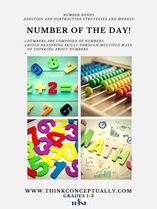
Number of the Day
Number of the Day is a fun way to develop understandings about number composition.  It supports the development of counting strategies as students work towards developing additive reasoning. Students can use these templates with 2, 3 or 4 digit numbers. This allows for differentiation. Students enjoy using dice to determine the number of the day.  Your students can use place value dice that come in 4 different colors if you have a set of those. This makes it fun to find a number to work with and then use it to demonstrate understandings about number. 

Access and Download here

Picture
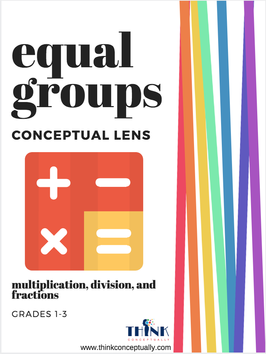
 Equal Groups
These learning engagements are intended to be used with math manipulatives and/or in a guided math group working collaboratively. I recommend that the teacher use questioning to both guide and deepen understandings as students explore the concept of equal groups. The multiple ways to help students both work with and visualize equal groups can be done with cubes, blocks, arrays, and fraction materials including clocks. There are multiple strategies to access and build upon while constructing understandings for additive, multiplicative and proportional reasoning. ​

SIDENOTE: While watching, Pam Harris' free course, she made a connection to what I have built in equal groups that offers an extension. She refers to building additive and multiplicative relationships. Think about a number like 72 and what ways can we use addition and multiplication to arrive at the 72
​

Access and download here
Picture
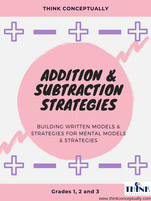
Addition and Subtraction Strategies
Use these as anchor charts, or use as a guide during centers or to learn a new strategy or model yourself.
Tally Marks
Using Ten Frames
Base 10 Blocks
Open Number Line Model
Arrow Strategy
Using Legs
Make Quick Tens Strategy
Compensation Strategy
Chip Diagram Model
Expanded Form for Addition I
Expanded Form for Addition II
Expanded Form for Subtraction 

​
Access and Download here

Picture
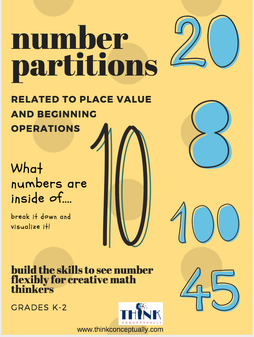
Partitioning Boards
As an international educator, I have learned different strategies for mathematics instruction by working with international colleagues. One in particular is partitioning. With partitioning, students learn to think flexibly about a number and visualize what numbers are inside of a given number before introducing the operations of addition and subtraction. This is a strategy used to lead to understandings about place value; it builds number flexibility to implement a variety of addition and subtraction strategies with facility. I have created activities for students to use when learning to partition from 10 - 20 in groups of 2, 3 and by ones & tens; number of the day; and sheets for numbers above 20. These can be done in pairs or individually. 

SIDENOTE: While watching, Pam Harris' free course, I saw her make a connection to partitioning for students even in high school. She plays a game called 'I have, you need' using numbers to 1000. It builds on this same concept of partitioning. I have 255, what do you need? 745. It is a great game for partitioning up to 1000 mentally for students who are ready for it. She calls it partners to 100 or to 1000. While problem solving with high school students, she uses this strategy time and time again. 

Access and Download here

PYP Units of Inquiry

These are examples of Research Booklets that I have created for my grade 2 students to scaffold the research process based on their language and skill needs. Inquiry is about curiosity that leads to questioning. Then leads to a research cycle where students are developing skills for lifelong learning. These are PDFs and not editable as they are not intended to be used as is for another group of students. As every group is different, I have made changes and prepared for each unique unit of inquiry's context and the students in the room. However, if you are new to the PYP, you may find it useful to see what has been created and used successfully to scaffold the inquiry process through each PYP transdisciplinary theme.
Picture

Who we are

Conceptual Lens: Healthy Choices
Click here to access graphic organizer
Picture

Where we are in place and time

Conceptual Lens: Settlements, Landforms
Click here to access
​Graphic Organizer


Picture

How we express ourselves

Conceptual Lens: Performance
Click here to access
Picture

How the world works

Conceptual Lens: Materials
Click here to access Version 1
Click here to access Version 2
Conceptual Lens: Innovation
Click here to access
Picture

How we organize ourselves

Conceptual Lens: Organizations
Click here to access Version 1
Click here to access Version 2
Conceptual Lens: Systems
Click here to access
Picture

Sharing the planet

Conceptual Lens: Conflict
Click here to access

Home

About

Services

Menu

Contact

Copyright © 2015
  • Home
  • Services
  • Free Resources
  • Blog
  • About
  • Contact